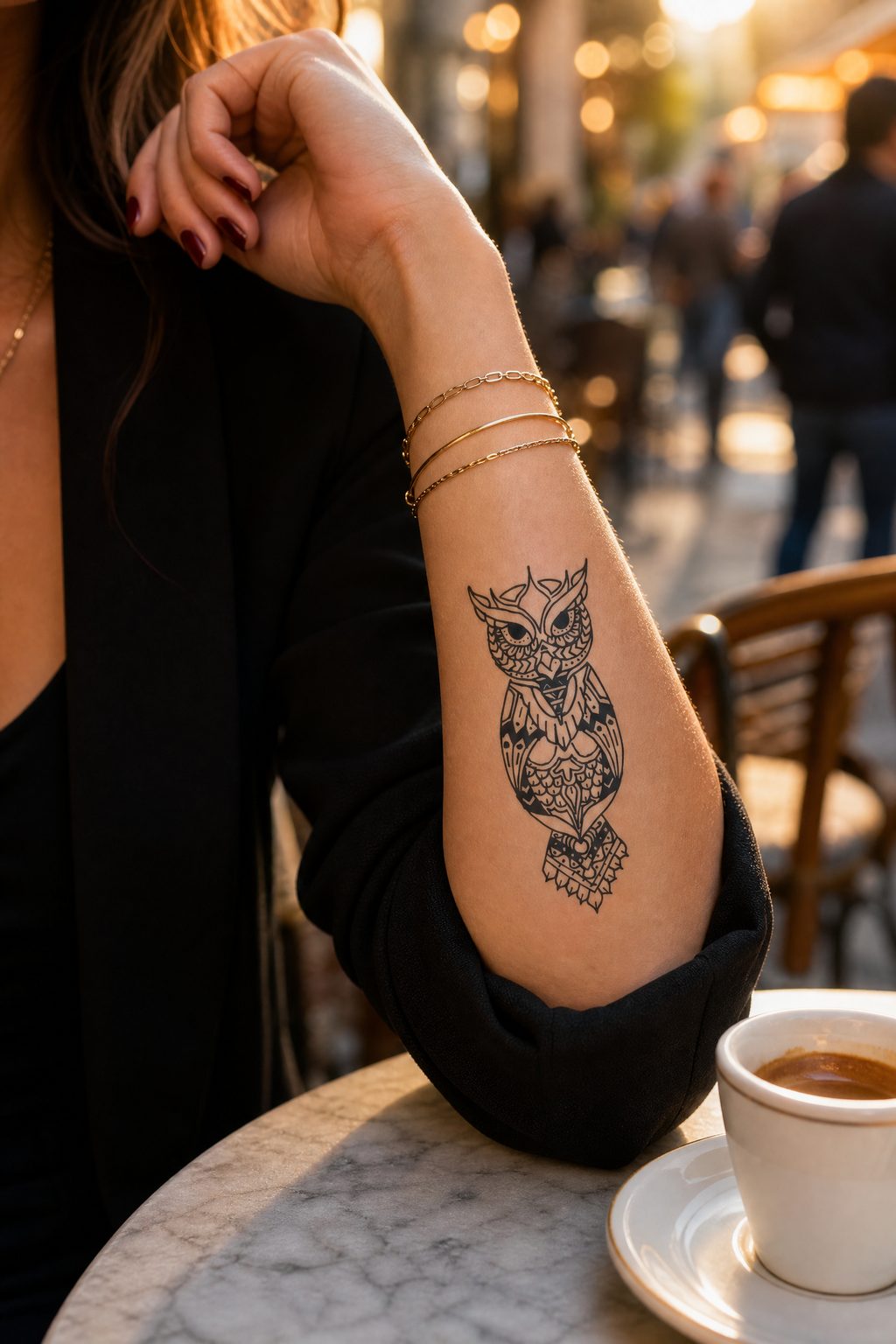

An eagle tattoo, in most of the heraldic and historical traditions we have documented, points to power, courage, and a broad perspective—the idea that the person wearing the bird sees farther and acts with greater resolve than those around them. Its exact meaning, however, depends on the emblem you have in mind: the eagle on Romania’s coat of arms tells a different story from the Roman legions’ aquila or the American bald eagle, even though all three draw on the same basic image. This guide explores the real sources behind each version, explains why the eagle is associated with keen eyesight as well as power, and presents several styles and placement options for a design from the InkLabs collection.
- The eagle on Romania’s coat of arms holds a cross in its beak and is crowned with the Steel Crown, added in 2016; the second item in its talons differs by source—sword and sceptre according to Romanian Wikipedia, sword and mace according to English Wikipedia.
- The same bird was the sacred standard of the Roman legions and, separately, the national emblem of the United States from 1782—two distinct historical stories that explain why this motif keeps appearing in symbols of power.
- The eagle’s keen eyesight, its most highly developed sense, is why the design is often read as a symbol of clarity or focus, not just brute strength.
What does an eagle tattoo really symbolize?
In the heraldic and historical records we checked for this guide, the eagle is consistently associated with a relatively stable set of qualities: courage, resolve, rising to great heights, power, and majesty. In Romanian heraldry, these qualities are explicitly attributed to the golden eagle, and its use as a national symbol dates back to the union of the Principalities in 1859 (source: Coat of arms of Romania - Wikipedia). This is not a universal meaning that applies across every culture, but rather a thread that runs through the specific emblems discussed below—the country’s coat of arms, a legion’s standard, and a nation’s insignia. Precisely because the meaning is tied to a particular story, choosing a style and composition matters just as much as the symbol itself. The following sections explain exactly what each historical version means before moving on to the practical design considerations.
If you’re interested in animal symbolism in general, not just the eagle, the InkLabs guide to animal tattoos and their meanings puts the motif in a broader context; for birds as a group, from flocks to images of flight, the article dedicated to bird tattoos covers the ground this guide leaves aside.
The eagle on Romania’s coat of arms: power and national history
For anyone who wants a tattoo with clear roots in Romanian history, the country’s coat of arms is the most thoroughly documented starting point. There are, however, two versions of the Romanian heraldic eagle, and it’s worth keeping them separate because the insignia the bird carries are not the same.
What the eagle holds in its beak and talons
On Romania’s current coat of arms, the eagle holds a cross in its beak and is crowned with the Steel Crown, which was only added in 2016; the sources, however, do not agree on the other two insignia in its talons. Romanian-language Wikipedia describes a sword and a sceptre (source: Stema României - Wikipedia), while English-language Wikipedia describes a sword and a mace on the same national coat of arms—the former associated with Stephen the Great, the latter with Michael the Brave (source: Coat of arms of Romania - Wikipedia). This is not a separate regional version: the only real connection between the coat of arms and Argeș County, noted by the same English-language source, is that the golden eagle motif has its historical roots in the coats of arms of Argeș, Pitești, and Curtea de Argeș, known as the “nest of the Basarabs”—a story about the motif’s origins, not about a different set of insignia held in its talons. For a tattoo intended as a historical tribute, the discrepancy between the two descriptions really matters: it’s worth checking an official source (the 2016 heraldic law or the National Heraldry Commission) before asking for the exact insignia you want to depict, rather than mixing elements from both versions.
How long has the eagle been a symbol of the country?
The Wallachian eagle, the direct ancestor of today’s coat of arms, is documented as far back as January 20, 1368, during the reign of Vladislav I, making it one of the oldest heraldic insignia used in what is now Romanian territory. The design we know today, however, was created much later, in 1921, by heraldist József Sebestyén, at the request of King Ferdinand I (source: Stema României - Wikipedia). Between these two moments lies a long history of political change, during which the eagle remained the symbol connecting the historic principalities to the modern state—the reason a tattoo based on this coat of arms reads more as a tribute to historical continuity than as a simple decorative image.
The eagle as a symbol of power in other historical emblems
Beyond the Romanian coat of arms, two other well-documented emblems explain why the eagle became the default choice for power and authority in several cultures and eras.
In ancient Rome, the eagle (aquila) was a legion’s sacred standard, directly associated with Jupiter. According to the historical tradition attributed to Pliny—which is disputed by other evidence showing that legions in the late Republic and early Empire continued to use symbols such as the bull or the wolf—Gaius Marius established it in 104 BC as the legions’ sole animal symbol, replacing the wolf and boar used until then; losing an aquila in battle was considered such a great disgrace that Rome would devote years of military campaigns just to recover it (source: Aquila (Roman) - Wikipedia). This connection to military honour, not just physical strength, is one reason the eagle often appears in tattoos as a symbol of a commitment or a value someone refuses to abandon.
At the other end of history, the bald eagle was chosen as the national emblem of the United States in 1782. The species underwent a drastic decline in the 20th century due to habitat loss and chemical contamination, but recovered after sustained conservation measures and was removed from the list of threatened species in 2007 (source: Bald Eagle - U.S. Fish & Wildlife Service). This story adds a nuance that older emblems do not have: the eagle is not only a symbol of power gained, but also of power regained after a period in which the species itself was vulnerable.
If you’d like to explore other motifs connected with strength or freedom, not just the eagle, you’ll find a broader comparison in the article about symbols of power and in the overview of symbols of freedom, where the eagle is just one of the motifs discussed.
Why is the eagle associated with keen eyesight and clarity?
In addition to its heraldic history, there is a concrete biological reason why the eagle is commonly associated with clarity and focus. Keen colour vision is the bald eagle’s most highly developed sense and its main tool for spotting prey from a great distance (source: Bald Eagle - Smithsonian's National Zoo). The sources consulted confirm only that this is its most highly developed sense, without giving an exact figure for how many times better it sees than a human, so any numerical comparison you encounter elsewhere generally has no verified basis. What remains well-founded is the logical connection: a bird that hunts by observing from a height, rather than by brute force, helps explain why people associate the motif with the idea of “seeing far” or making clear-headed decisions, not just aggression.
Eagle tattoo styles to choose from
Once the meaning is clear, the real choice shifts to style—and here the InkLabs catalogue offers several distinct directions, not just variations on the same image.

The Eagle design is the collection’s most literal portrait: it focuses on the details of the feathers and the bird’s gaze, with no other added elements, and works well for anyone who wants the eagle itself to be the main subject, rather than an accessory to a larger composition. The Vultur și Stele design takes a different direction: it combines an eagle’s head with blooming roses and shining stars in a richer illustrative composition, suited to anyone who wants to connect the symbol with other themes rather than depict it on its own. The Clarviziune design takes a neo-traditional approach and overlays an eagle’s portrait on the face of an old warrior, suggesting a symbolic connection between the person and the bird—a more narrative composition, suited to anyone who wants a story, not just a symbol.
For a complete picture of the range, it’s worth noting that other pieces in the catalogue, such as Rege Ceresc (an eagle’s head emerging from clouds, with an aggressive gaze) or Spirit Marin (an eagle paired with a ship in a nautical-inspired composition), use the same motif in different visual styles—one more dramatic, the other more maritime and narrative—with neither style objectively “better” than the other; the choice depends on what you want the composition as a whole to convey. If you’d rather keep just the wing or feathers, without the bird’s whole body, the article about wing tattoos covers exactly that direction.
Where is the best place to put an eagle tattoo?
Choosing a placement depends first and foremost on the size of the composition and how much detail you want to remain visible. A composition with wings spread wide needs the surface of the chest or upper back to keep the feathers and wing outlines legible; compressed into a small area, this kind of image tends to lose precisely the details that make it read as an eagle rather than a generic bird silhouette. A portrait or head-and-shoulders version, on the other hand, such as the Eagle design, also works well at a smaller scale on the forearm or upper arm, because the details that matter—the eye and the feathers around the head—remain visible even when the image is more compact. In practice, the decision comes down to a simple question: do you want the bird’s full wingspan, or is its head enough to convey the symbol? For a more general guide to choosing a design and placement for your first tattoo, this InkLabs article goes through the same questions of proportion and scale as they apply to any motif, not just the eagle.
Why it’s worth trying a temporary design first
Once you’ve chosen the style and placement, one variable remains difficult to estimate from the product photo alone: how the proportions actually look on your own skin as your body moves normally. A temporary or semi-permanent design from the Temporary Eagle Tattoos collection gives you exactly this information before any permanent decision—you can see whether the wingspan looks the way you imagined on your chest, or whether a smaller portrait on your forearm preserves the detail you want. The InkLabs guide to why it’s worth testing a tattoo before making it permanent explains this reasoning in detail; it applies to any motif, not just the eagle. Until you’re ready for the permanent version, trying it directly on your skin remains the clearest way to check whether the symbol and style you chose suit you.