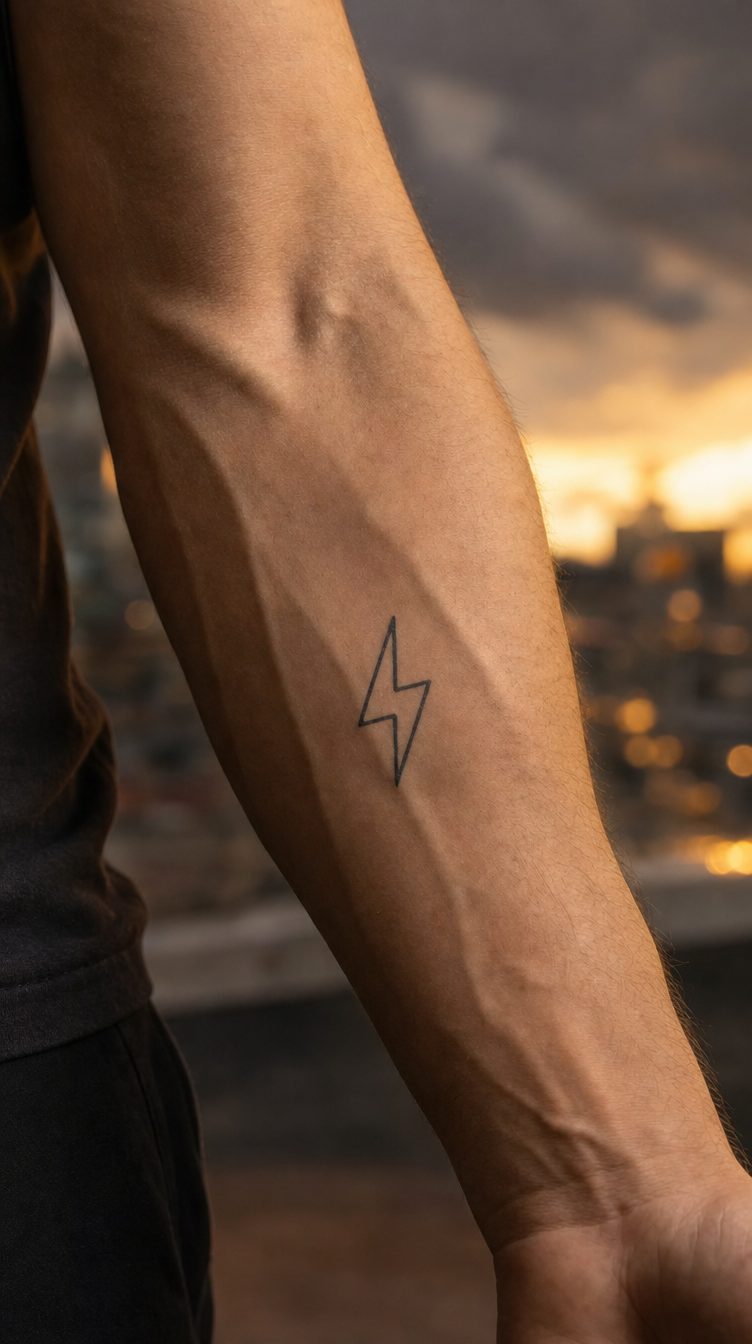

The simplest way to choose a travel tattoo is to start with what you want to remember, not with a single destination you’ve visited: most designs in this category are based on four symbols with their own meaning — the compass, the world map, coordinates or a passport stamp, and the airplane — each saying something different about movement, direction, or a particular memory. Because your chosen symbol will remain visible long after you decide, the most practical step is to see how it looks directly on your skin first, at the size and in the place you have in mind.
- The compass conveys the idea of direction and the determination to find your own way, rather than a particular destination.
- The world map works best as a simple backdrop for a marker, a country outline, or a route.
- Coordinates and passport stamps mark an exact place or moment, so they’re worth checking carefully before you wear them.
- The airplane and other symbols of movement directly convey the act of setting off, especially in a minimalist design.
Why choose a travel tattoo
A travel tattoo most often marks not a single destination, but the broader idea of movement, discovery, or a memory connected to a journey — in fact, the word “wanderlust,” which often appears alongside these designs, entered the English language in 1902, from the German “wandern” (to roam) and “Lust” (desire), and describes this very urge to explore (source: Wanderlust, Wikipedia). Interest in these symbols has also grown alongside the number of people working remotely while travelling, a trend that accelerated visibly after the pandemic (source: Digital nomad, Wikipedia). Each of the commonly worn symbols — the compass, map, coordinates, passport stamp, and airplane — tells a different story: some are about direction, others about a particular place, and others about the simple act of setting off. Precisely because it stays on your skin for a long time, it’s worth seeing your chosen symbol at its actual size, on the area you have in mind, before making any permanent decision.
The compass: direction and determination
A compass rose is a diagram showing the cardinal directions and the points in between, used for centuries in navigation and cartography long before it became a decorative motif; its first ornamented example on a map is attributed to Cresques Abraham, in the Catalan Atlas of 1375 (source: Compass rose, Wikipedia). In tattoos, the compass is usually read as a symbol of direction and the determination to find your own way, not as a prediction of a particular destination. Compass designs in the Temporary Compass Tattoos collection range from a simple outline to a detailed drawing with needles and a complete dial, making them useful for testing how visible you want the symbol to be throughout an ordinary day.
The world map: places visited and places on your list
In its simplest form, a world map shows the outlines of the continents; because creating a flat map involves projecting a sphere onto a 2D surface, styles range from political maps, with marked borders, to physical or purely decorative maps (source: World map, Wikipedia). As a tattoo, the map is most often worn as a backdrop for an added element — a marker, a country outline, or a route — rather than as a detailed drawing with city names, which would become illegible at skin scale. A temporary version lets you compare the full outline of the world with a version reduced to a single region before choosing what you want to wear permanently.
GPS coordinates and passport stamps: precise memories
A passport stamp officially marks entry into or exit from a country, and its design varies from one country to another — some countries stamp only on entry, others use stickers, and still others have already dropped stamps in favour of digital systems (source: Passport stamp, Wikipedia). This very variation explains why some people choose to reproduce the exact stamp from an important trip as a personal memory, rather than as a generic symbol. Geographic coordinates — latitude and longitude — are a more discreet version of the same idea, used to mark the location of a trip, a birth, or an event connected to a journey.
Check the source of the coordinates before wearing them
Because they’re exact figures, any transcription error is immediately noticeable to anyone who knows how to read a map. The most important practical step here is to double-check the coordinates against their source — a map, your phone’s GPS, or a travel document — before wearing them, whether you first choose a temporary version to try out or are already thinking about something permanent.
The airplane and other symbols of movement
An airplane, a travel ticket, or a suitcase are direct symbols of setting off, unlike the compass or world map, whose roots go back centuries to navigation and cartography. Precisely because their message is clear without extra details, these shapes are often chosen in a minimalist version, as a small element on the wrist or collarbone. They pair well with a compass or map in a single design if you want to convey both the idea of setting off and the idea of finding your way. Other symbols sometimes worn alongside the travel theme, such as the anchor or the swallow, come from maritime tradition and each has a broader story, covered separately from the specific theme of movement discussed here.
A tattoo for every trip: how to choose the size and placement
Some travellers choose to add a small tattoo after every important trip, a habit that works best with discreet designs that are easy to repeat on the wrist, ankle, or forearm — areas covered with practical ideas in the InkLabs guide to small tattoos. Before repeating a symbol several times, it’s worth trying the size and placement once, so you know exactly how it sits on your skin and how visible it remains throughout an ordinary day; the reasons for taking this step before making a permanent choice are explained in detail in the article about trying out a tattoo.

The Journey design is a direct example of this kind of test: you can apply it to your wrist or forearm and literally compare how it looks alongside the rest of your everyday style. If the symbol you want to repeat on every trip is a personalised design — coordinates or a recreated stamp — the custom temporary tattoo collection is where you can see how those figures or that outline become a wearable design.
Ultimately, choosing a travel tattoo comes down to what you want to remember: a direction, an exact place, or simply the act of setting off. Trying out your chosen design beforehand, at its actual size and in its actual placement, gives you the time you need to decide whether that symbol deserves to stay with you long after the holiday is over.