
A meaningful tattoo for men does not necessarily mean a more complicated design, but one whose story actually exists and can be explained in a few sentences, rather than merely summed up by a beautiful legend invented for social media. The list below groups 30 popular symbols into easy-to-recognize categories — strength and courage, direction and purpose, inner balance, freedom and the road traveled, power and transformation, family and remembrance — and explains, for each one, the documented or widely accepted origin of its meaning. You can use the list as a starting point: first choose the category that describes what you want to say about yourself, then look for the specific symbol and a design that suits it.
- Each symbol below comes with a verifiable or widely recognized origin, not just an aesthetic interpretation attached later.
- The same symbol can mean different things in different cultures, so choosing it also means choosing the story you want to carry.
- A temporary or semi-permanent design lets you see the artwork at the size and on the area of your body you are considering, which helps you decide on the size and placement before taking any permanent step.
- Religious or cultural symbols, such as Om, the cross, the lotus, or yin-yang, deserve to be approached with context, not reduced to purely decorative designs.
What makes a tattoo a truly personal symbol
The difference between a symbol that really means something and one that just looks good lies in whether the story behind it can be verified. An ancient legend documented by historians, a craft tradition passed down through generations, or a moment from mythology that you can read about elsewhere are genuine points of reference; a generic description such as “symbolizes inner strength” written without any source beneath an attractive image is not. It is also worth knowing that the same design carries different stories depending on the culture it comes from: the wolf is a threat in one folk tradition and tested loyalty in another, and choosing a symbol implicitly means choosing one of these stories as your own. Since the decision will be connected to your skin for a while, testing matters: a temporary or semi-permanent design lets you see the outline, size, and exact position on the area you are considering, which is useful for deciding on the design but says nothing about how a permanent tattoo made with needles would hurt, heal, or look exactly — those remain separate questions to discuss with a licensed tattoo artist.
Symbols of strength and courage
Men who want to convey resilience, a position of strength, or deliberate courage generally choose animals or images associated with natural dominance. The stories behind them range from mythology to heraldry, but they all have one thing in common: their subject had to demonstrate strength to survive or lead.
The lion
The lion appears in ancient Egypt through the lion-headed goddess Sekhmet, “the powerful one,” who personified the aggressive and forceful aspect of the divine (source: World History Encyclopedia). A few thousand years later, the lion became one of the most widely used symbols in medieval heraldry, worn on shields and tunics for quick visual identification on the battlefield, including the famous three-lion design of King Richard I of England, intended to command respect (source: World History Encyclopedia). The two traditions, separated by thousands of miles and centuries, reach the same conclusion: the lion reads as a symbol of strength and rank.
The wolf
The wolf is more complicated than it first appears. In Norse mythology, the great wolf Fenrir is bound to the god Tyr by a genuine relationship of trust before the gods deceive and restrain him — Tyr sacrifices his hand precisely in that moment of mutual loyalty (source: World History Encyclopedia); therefore, the wolf does not read only as danger or wild instinct, but also as loyalty to a pack or to those close to you. If you want the full story of wolf symbolism, including its variations across several traditions, the article dedicated to the wolf goes into detail; here, we’ll stick to the essentials.
The bear generally appears as a symbol of protective strength and composed calm, the tiger as a symbol of focus and controlled power, and the eagle as a symbol of a bird’s-eye perspective and the ability to see clearly before acting. All three are widely recognized associations rather than legends with a single documented source, which does not make them any less valid as choices, only less rooted in a specific historical moment.
Symbols of direction, guidance, and purpose
This category suits men choosing a tattoo around an important decision or a change of direction in life. All the symbols below are connected, in one way or another, with finding your way.
The Compass
The compass was invented in China: the ability of magnetite to indicate direction was documented for navigation between the ninth and eleventh centuries, and Chinese sailors used it widely for maritime navigation during the Song dynasty, from 960 to 1279 (source: History Cooperative). Later, the compass became the tool sailors around the world used to literally find their way home, which explains why it remains a universal symbol of personal direction and clarity in a moment of uncertainty.

Vegvisir (the Norse wayfinding symbol)
Vegvisir, also known as the “Norse compass,” is an Icelandic wayfinding symbol first attested in the nineteenth-century Huld manuscript; there is no evidence that it was known or used in the Viking Age, so the most accurate description is an Icelandic folk-magic symbol, popularly associated with the Nordic maritime tradition, rather than an authentic Viking artifact (source: Norse Mythology for Smart People). The Runic Compass design from the InkLabs collection draws visually on this idea of wayfinding through an abstract illustration of a stylized runic compass, making it useful for anyone who wants a Norse aesthetic without claiming an age the symbol does not have.
The nautical star
The five-pointed nautical star represented Polaris, the North Star, to sailors—the landmark used for nighttime navigation; sailors wore it as a kind of talisman that was believed to guide them safely home (source: gCaptain). Today, it works as a symbol of keeping your bearings, whatever the circumstances.
The arrow
In most current interpretations, the arrow remains a general symbol of direction, focus, and moving forward, without a single documented story behind it. The various “rules” about facing left or right or pointing downward, which circulate on commercial jewelry websites, have no solid historical source, so the most honest way to read it is as an image of a journey with a clear purpose, not as a code with fixed rules.
The key
The key works as a symbol of unlocking a new stage or an opportunity you have decided to accept, a direct and easily recognized association that needs no further explanation.
Symbols of balance and inner peace
For men who want a tattoo connected to self-control, calm, or spiritual grounding, the symbols below come from philosophical and religious traditions that deserve to be approached with context, not treated as decorative shapes.
Yin-yang
In Chinese philosophy, yin-yang expresses the idea that opposing forces — light and darkness, active and passive — are interdependent: each half contains a seed of the other, and harmony comes from balance, not from one side dominating the other (source: World History Encyclopedia). The Yin Yang design from the InkLabs collection preserves this exact idea of balance between light and shadow, without turning it into a simple graphic motif.
Om
Om is a sacred syllable central to Hinduism and other spiritual traditions of South Asia, associated with the primordial vibration of the universe and used in meditation and ritual; it deserves to be worn with an understanding of its religious context, not just as a pleasing graphic form.
The lotus
The lotus grows out of mud and opens cleanly above the water, which is why several Asian traditions connect it with purity and spiritual development achieved by passing through a difficult period.
The tree of life
The tree of life appears in similar forms in separate traditions — from Celtic symbolism to Norse symbolism — as a representation of the connection between roots, the present, and continual growth, making it a suitable choice for someone who wants to mark continuity rather than an isolated moment.
The cross
For those who wear it out of religious conviction, the cross remains the central symbol of the Christian faith; as with the other religious symbols on this list, it makes sense to choose it with an awareness of its significance, not as an accessory.
Freedom and the road traveled
This category includes men who define their identity through movement, travel, or the idea of leaving something behind in order to move forward.
Infinitum
The infinity symbol, the lemniscate (∞), was introduced with its mathematical meaning by John Wallis in 1655, in his work on conic sections, and then used again in “Arithmetica Infinitorum” in 1656 (source: MacTutor History of Mathematics); from there, the symbol informally became a visual shorthand for “without limit,” which is why today it reads more as a “continuous journey” than as a fixed finish line. The Infinitum design from the InkLabs collection combines the infinity symbol with an arrow, conveying the idea of moving forward without stopping at a single point.

The swallow
In maritime tradition, a tattooed swallow marked the first 5,000 nautical miles a sailor had traveled, while a second swallow, often on the opposite shoulder, marked a safe return home, because swallows were among the first birds sailors saw as they approached land (source: Cruising World). Today, it serves as a marker of a journey completed and a return to a safe place.
The mountain, the wave, and the ship’s wheel
The mountain visually sums up the idea of overcoming an obstacle through sustained effort; if you want more ideas featuring landscapes and natural elements, the article dedicated to nature tattoos explores this subject in detail. The wave or ocean reads as a symbol of constant change and the ability to adapt to it, while the ship’s wheel sums up the idea of staying on your chosen course even when conditions change.
Power and transformation
This category suits men marking a turning point, a change in identity, or a return of control over their own lives.
Lightning
In Greek mythology, Zeus’s thunderbolt, forged by the Cyclopes, was his signature weapon and the visual sign of his authority over the sky and, by extension, all of creation (source: World History Encyclopedia), and this is the origin of the modern reading of lightning as sudden power or rapid change. The Lightning design from the InkLabs collection preserves this meaning in a minimalist line, easy to apply to more discreet areas.

The phoenix
The phoenix, found in several mythological traditions in similar forms, continually rises from its own ashes, making it a natural choice for someone marking a major transformation. For the full mythology behind it and other legendary creatures, the article dedicated to fantasy and mythology tattoos goes much deeper.
The skull
The skull, read as a memento mori rather than an attention-grabbing image, reminds us that time is limited and worth living with intention; it is a choice that usually calls for a real discussion with the artist about style, so it does not slide into visual cliché.
The dagger
The dagger works as a symbol of deliberate protection or a fight already faced and won, rather than gratuitous aggression.
The crown
The crown marks a position earned through effort — control over your own life or a difficult situation — not necessarily social status, especially when worn by someone who has been through an important change.
Family, love, and remembrance
This category includes men who want to mark a relationship, a loss, or a commitment, without made-up sentimental wording.
The anchor
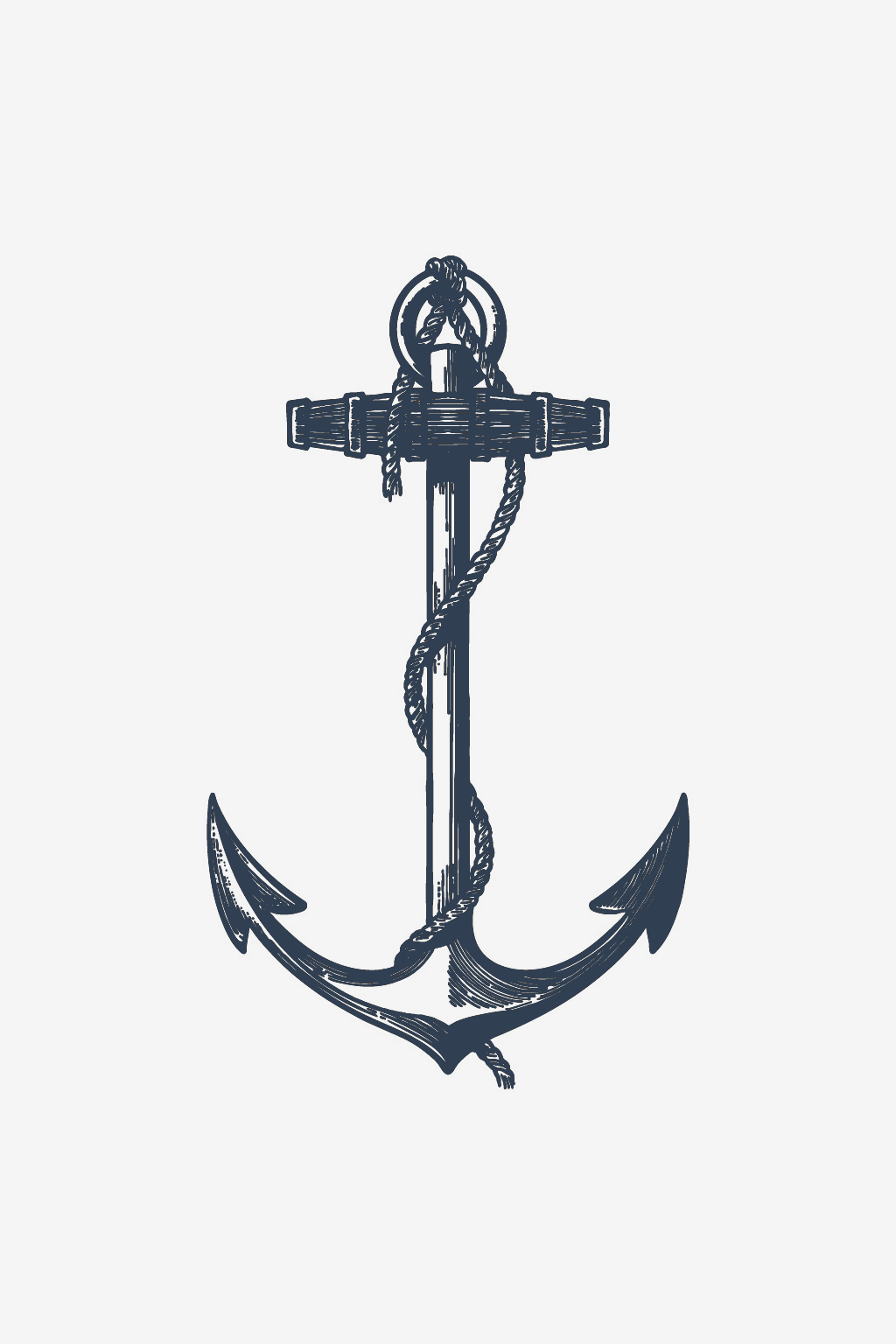
The anchor is one of the oldest Christian symbols, appearing in catacomb inscriptions from the first centuries of the Christian era — in the Catacomb of Priscilla alone, there are approximately seventy such examples dating from before the fourth century — and represents hope anchored in something stable, drawing on the description in Hebrews 6:19, where hope is called “an anchor of the soul” (source: Catholic Encyclopedia). Before that, in maritime tradition, the anchor symbolized hope and a safe return home. The two layers explain why the anchor today reads as stability and as staying connected to family even when you are far away.
The rose, the heart, angel wings, and the feather
In most current interpretations, the rose carries the meaning of love accompanied by an awareness that beauty also has a fragile side. The heart remains a direct symbol of affection or an important bond. Angel wings usually mark the memory of a loved one who is no longer physically present. The feather reads as a symbol of lightness and a memory carried gently rather than as a burden.
How to test a symbol before you decide
A temporary or semi-permanent design shows you the artwork at exactly the size and on the area of your body you are considering, which is useful when deciding on the design, size, and placement. It does not tell you, however, how it would hurt, how it would heal, what risk of an allergic reaction there would be, or exactly how a permanent tattoo would look over time — those are separate questions for a licensed tattoo artist when you get to that point.
In practice, the simplest approach is to start with the category that describes what you want to say about yourself right now — strength, direction, balance, freedom, power, or family — and choose the symbol that suits you, not necessarily the most popular one. Once you have a symbol in mind, you can browse the Temporary Symbol Tattoos collection to see more variations of it and related designs. And if you have already decided on a symbol and also want to know exactly where on your arm it looks best, the guide to arm placement explores that very topic. For extra visual inspiration beyond meaning, our gallery of designs for men is a good place to start.