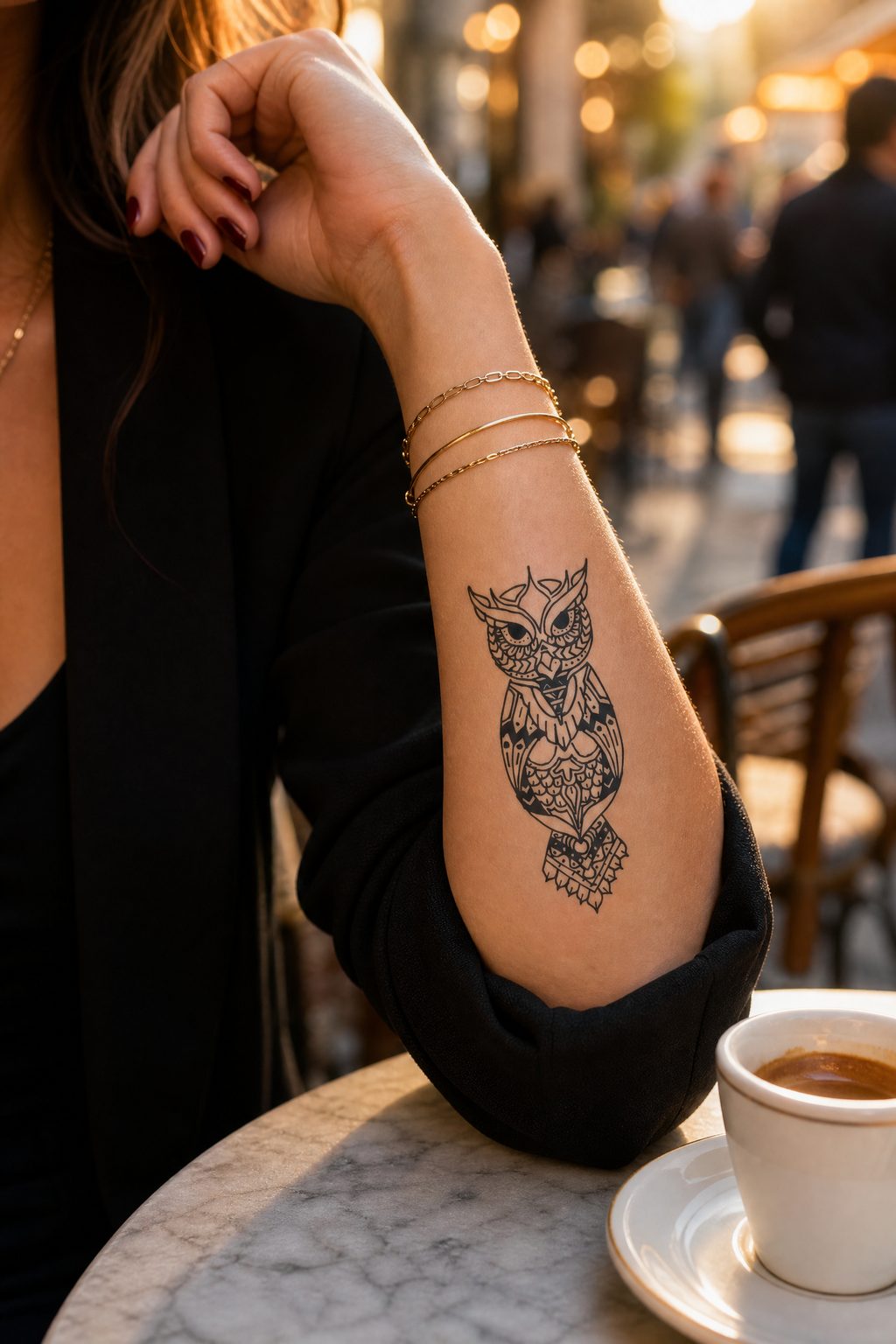

An Unalome tattoo traces, from bottom to top, someone’s path to clarity: a spiral at the base, then a line that gradually straightens, ending in one or more dots. The symbol comes from the Theravada Buddhist tradition of Southeast Asia, where the spiral represents confusion and the trials a person goes through, the straightening line marks an increasingly clear sense of direction, and the dots at the end indicate the state of enlightenment toward which that path leads. Most often, the Unalome is paired with a lotus, and in the Inklabs catalog you’ll find this exact pairing in a set of fine-line lotus and Unalome designs, which you can wear temporarily or as a semi-permanent tattoo before making any permanent decision.
- The name comes from Sanskrit and Thai and is connected to a curl of hair between Buddha’s eyebrows, not to a decorative design invented for tattoos.
- Each part of the symbol plays a role in how it is read: the spiral shows the trials, the straightening line shows the direction, and the dots at the end mark enlightenment.
- The lotus appears alongside the Unalome because it tells the same story in a different visual language: purity rising to the surface right from the midst of difficulty.
- A temporary or semi-permanent design helps you choose the right size and placement, but it does not replace the ritual meaning of a traditionally applied Sak Yant tattoo.
What is an Unalome tattoo?
The word “Unalome” comes from the Thai อุณาโลม (uṇālom), itself derived from Sanskrit: ūrṇā, “curl” or “curly hair,” and loma, “hair.” The terms refer to the ūrṇā, the curl of hair between Buddha’s eyebrows, one of the traditional physical marks associated with him in Buddhist texts (source: Wiktionary). This is where the symbol’s visual logic comes from: a curl that gradually unfolds, not an ornament chosen at random.
The symbol is part of the set of Theravada Buddhist images used in Southeast Asia and appears frequently in Thailand, Cambodia, and Laos in the tradition of sacred Sak Yant tattoos. The practice’s roots go back to yantra tattoos in the Khmer Empire around the 9th century, where local animist tattooing became intertwined with Hindu-Buddhist practice (source: Yantra tattooing, Wikipedia).
In its traditional form, a Sak Yant tattoo is applied by a monk or a trained practitioner, and the person wearing it is expected to follow certain rules for its spiritual meaning to remain valid (source: Yantra tattooing, Wikipedia). That is precisely why the symbol is treated as sacred, not as a purely decorative design, and this distinction matters when you choose to wear its visual form without the ritual component that gives it its full meaning in its tradition of origin.
How to read the symbol: the spiral, line and dots
Read from bottom to top, the Unalome follows a simple, consistent logic from one design to another. The spiral at the base represents confusion, hardships, and distractions a person goes through before finding a clear sense of direction. As the line rises, it gradually straightens, signaling an increasingly clear direction and purpose. At the end, one or more dots mark the goal toward which this entire path leads: the state of enlightenment described in the tradition from which the symbol originates (source: The Unalome: Origins, History and its relationship to Sak Yants).
Why there is no single “correct” design
Design variations, such as a double spiral, a few extra loops, or a different angle to the line, change only how long or complicated the path looks, not the basic logic of reading it from bottom to top. There is no fixed number of loops or dots required as a universal rule; what matters is that the spiral-line-dot structure remains recognizable, because it is what carries the symbol’s meaning forward, no matter how personalized the design is.
Unalome and lotus: why they appear together
In Buddhist symbolism, the lotus grows rooted in murky water and mud, but blooms cleanly above the surface. This makes it an image of the purity of mind that emerges right in the midst of ordinary difficulties, not in their absence (source: Lion's Roar).
For the same reason, the lotus is one of the eight auspicious symbols of Buddhism (Ashtamangala), where it represents the purity of body, speech, and mind, floating above the murky waters from which it grew (source: Ashtamangala, Wikipedia).
Paired with the Unalome, the lotus does not add a new story, but gives an additional visual form to the same idea already expressed by the spiral and line: movement through difficulty toward something clearer. That is why the two motifs so often appear together, including in the fine-line designs in the set discussed here, where the lotus complements the Unalome line without changing its meaning.
How to wear the symbol respectfully
A temporary or semi-permanent Unalome design shows you what the symbol looks like on your own skin, but it is not a ritual Sak Yant tattoo and does not carry the blessing or ritual meaning that those tattoos have in their tradition of origin.
Understanding the symbol’s origins before choosing a design is part of wearing it respectfully, rather than treating it as a beautiful design detached from its meaning. It’s worth spending a few minutes reading about the spiral, line, and dots before choosing the version you’ll wear, whether temporary or, later, permanent.
The same care applies to any variation you choose: keep the spiral-line-dot logic intact instead of turning it into a design that merely resembles an Unalome without telling the same story about the path to clarity. If the symbol has drawn you to other spiritual motifs, the guide to the meaning of Buddha tattoos and respectful placement explores Buddhist imagery in general in greater depth, while the guide to the meaning of the yin-yang tattoo explores another East Asian symbol also built around balance and direction.
Where an Unalome tattoo works well
The design’s slender, vertical shape works well in narrow areas that follow a line, such as the spine, the inner forearm, or the area behind the ear.
On the wrist or ankle, a smaller version keeps the spiral and dots legible at a glance, without the details getting lost at a reduced scale.
A larger placement on the back or ribs provides enough space for the lotus-Unalome pair to sit side by side, rather than being squeezed onto a single narrow line. If you want to compare several geometric designs with symbolic meaning before choosing, the article about mandala tattoos explains another family of motifs built around symmetry and meaning.

Once you know what each part of the symbol means and why it often appears alongside a lotus, choosing a specific design becomes simpler: you consider the area you want to cover and how large you want the lotus-Unalome pair to be there. If you’re still deciding between a subtle version and a larger one, a guide to choosing the design and placement for your first tattoo helps you ask the right questions before wearing something permanent. The lotus and Unalome set is also available in the fine-line temporary tattoo collection, alongside other designs in the same delicate style, or in the Temporary Spiritual Tattoos collection, if you want to compare several symbols with similar meaning.