
A laurel wreath tattoo represents a victory or achievement that someone has earned for themselves, not a title or rank bestowed upon them. Its meaning reaches back to Greek mythology, where the laurel was sacred to the god Apollo, and in ancient Rome it became a visible sign of military triumph. If you choose this design, you are not choosing a generic symbol of victory, but a story with a very specific origin—and that story is worth knowing before you decide on the style and placement.
- The laurel wreath traces back to the myth of Apollo and Daphne and was originally dedicated to Apollo’s own domains—poetry, music and prophecy—not to competition in general.
- At the ancient Olympic Games, victors were honored with a wreath of wild olive, not laurel; the two wreaths are often confused online.
- In ancient Rome, a victorious general wore the laurel wreath for just one day during his triumphal procession; afterward, it was kept at home rather than worn again.
- Its meaning lives on to this day in terms such as the English “poet laureate” and in the expression “resting on one’s laurels.”
Origins: Apollo, Daphne and the beginnings of the laurel wreath
The best-known version of the origin story comes from Ovid’s Metamorphoses: the god Apollo pursues the nymph Daphne, and to escape him, she transforms into a laurel tree. Apollo then declares the laurel his sacred plant (source: Daphne (mythology) – Wikipedia). This one scene explains why laurel, rather than just any other leaf, became the symbol: because the plant is directly connected to Apollo through the myth, it became associated with everything he represented—poetry, music and prophecy—not competition in general. For a tattoo, this origin is more than just an anecdote: it explains why the wreath was a symbol of intellectual or artistic achievement from the beginning, and was only later applied to physical victories, not the other way around.
From the Greek victory wreath to the Roman triumph
This very connection to Apollo explains why the victors of the Pythian Games in Delphi, Apollo’s own festival, were crowned with laurel, specifically for poetic and musical achievements (source: Daphne (mythology) – Wikipedia). At the Olympic Games, by contrast, the victor’s wreath was usually made of wild olive rather than laurel (source: Laurel wreath – Wikipedia), a distinction that is often blurred online, even though the two wreaths represented different games and different kinds of achievement.
Rome later adopted the laurel wreath for a very different purpose: military triumph. A victorious general wore the corona triumphalis during his triumphal procession, together with a purple toga embroidered with gold (source: Roman triumph – Wikipedia). These insignia raised him almost to the level of a god or king for that one day, but Roman tradition explicitly expected him to keep them at home afterward instead of continuing to wear them in everyday life (source: Roman triumph – Wikipedia). The wreath was therefore deliberately conceived as a temporary honor, not as a lasting symbol of rule.
What the laurel wreath still means today
The connection to achievement has outlasted antiquity: graduates at Italian universities are still traditionally crowned with laurel, and it is from this very practice that the English title “poet laureate” for a court poet originates (source: Laurel wreath – Wikipedia). The expressions “resting on one’s laurels” and “keeping one’s laurels in view” also come from the same image and describe how someone deals with an achievement they have already reached: either they rest on it, or they keep in mind that a lead can shrink again.
For you, this creates a clear distinction from a crown tattoo: a crown represents bestowed rank or your worth as a person, while a laurel wreath marks an achievement you have earned for yourself, such as a degree, a goal you have reached or a difficult period you have overcome. If you choose this design, you carry this distinction as your own reason for choosing it, instead of wearing a generic symbol of victory whose origins no one knows.
Three styles of laurel wreath tattoo: Fine Line, illustrative and dotwork
Before deciding on a design, it’s worth taking a look at the three techniques most commonly used to create a laurel wreath. Each changes not only the look, but also how legible the wreath remains at a smaller size.
Fine Line: delicate and minimal
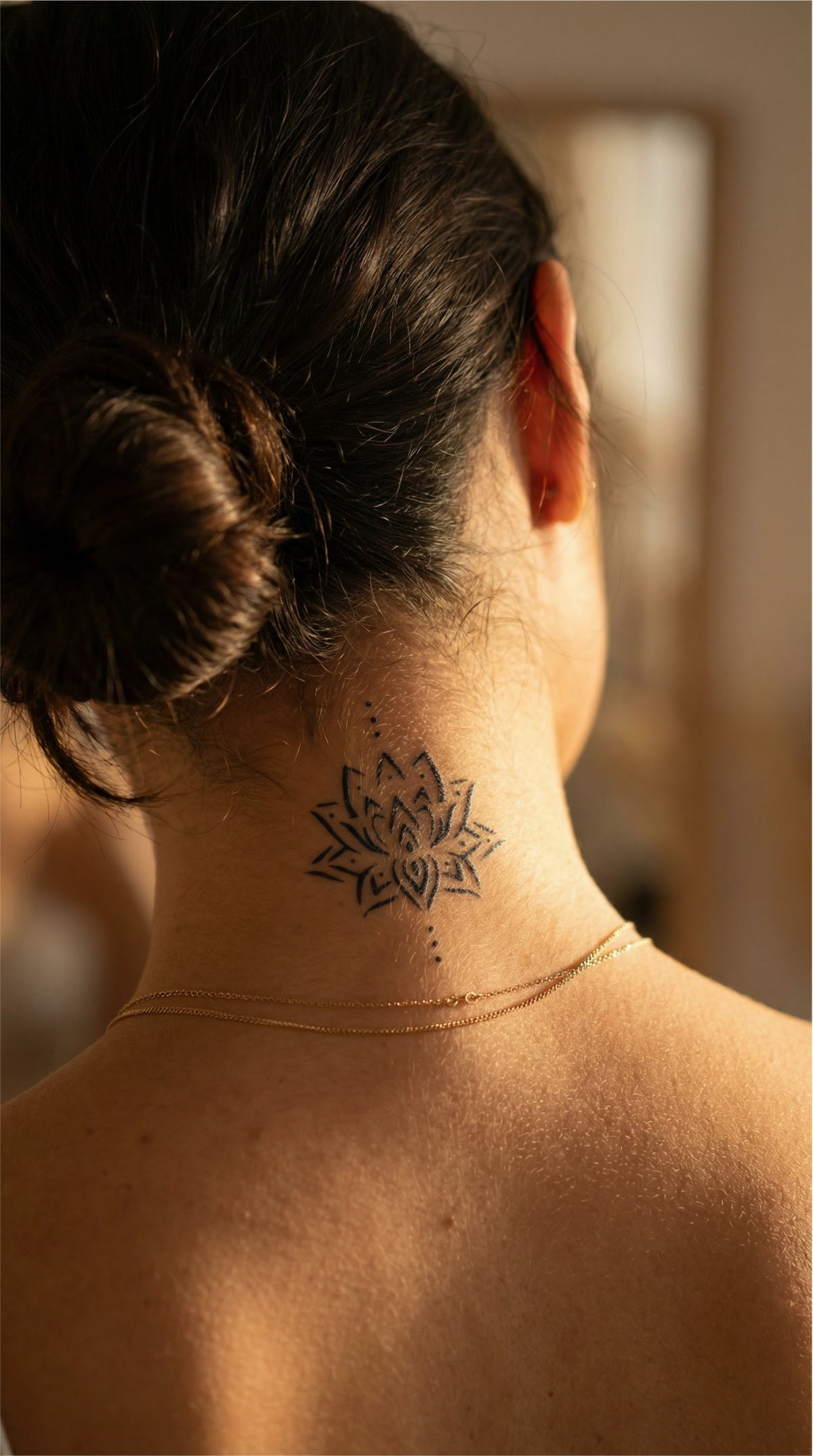
With Fine Line, each leaf and stem is drawn as a single continuous line, making the wreath look almost like a sketch rather than a solid image. This understated approach is also reflected in InkLabs’ delicate nature designs, which let you try out the size and effect on your own skin at your leisure.

Illustrative: fuller and more detailed
Illustrative designs use shading and layered leaf shapes, giving them considerably more visual weight than a simple line drawing and bringing them closer to a small botanical illustration than a sketch. If you’re interested in this style, you’ll find more examples of the level of detail this technique allows in InkLabs’ flower tattoo designs.

Dotwork: structured and dotted
With dotwork, leaves and berries are made up of individual dots rather than continuous lines or solid areas. The result looks structured and slightly weathered, and remains legible even at smaller sizes because contrast is controlled by the density of the dots, rather than relying on fine lines that can quickly blur in very small designs.
Placement and size: from a narrow bracelet to a full wreath
For a discreet personal symbol that doesn’t take up much space, a single branch or a narrow wreath band works well on your wrist, ankle or forearm. If you want a complete, closed wreath, though, you’ll need more room: on your upper arm or around your collarbone, the wreath shape can actually close into a ring rather than looking cut off at the edges.
Because the design represents an achievement you have earned, it’s also worth considering how visible you want this conversation to be: a placement on your forearm or upper arm is more likely to prompt others to ask about it, while your wrist or ankle keeps the story more private. For an overview of design and placement for a first tattoo, it’s worth taking an additional look before making your final decision. If you’d also like to compare the laurel wreath with other nature designs, you’ll find an overview in the article on nature tattoos.
Another reason to think carefully about the size: a wreath is a closed shape, so it works well as a frame for something personal in the middle, such as a year or a pair of initials naming the specific milestone the laurel symbolizes. If you want this variation, the wreath itself needs a slightly larger diameter than a simple outline, so the lettering or number in the middle remains easy to read and doesn’t blend into the leaves.
Before making it permanent: try out the laurel wreath first
A temporary or semi-permanent version shows you in advance how a particular size and placement actually look on your own skin, before anything permanent is created. With InkLabs’ semi-permanent ink, the design starts out light and bluish immediately after application and oxidizes within about 24 to 36 hours into a deeper blue-black that comes quite close to the depth of a real tattoo. How long it lasts afterward depends greatly on the location and care: it fades fastest in areas subject to a lot of friction, such as hands and wrists, while it lasts longer on the arm, ankle or ribs; hot water, tight clothing and heavy sweating also shorten its wear time.
This test shows only the design, size and placement. It says nothing about how a permanent laurel wreath will heal, feel, react to allergies or actually look in a few years—and you should not draw any conclusions about those things from a temporary version. If you still want to know why this intermediate step is worthwhile, you’ll find a more detailed explanation in the article Try a tattoo before making it permanent.
If you’re looking for a suitable nature design to try, the plant design collection is a good place to start: there you can take your time looking at a similar delicate or illustrative leaf design on your own skin before making your final decision about a permanent laurel wreath.