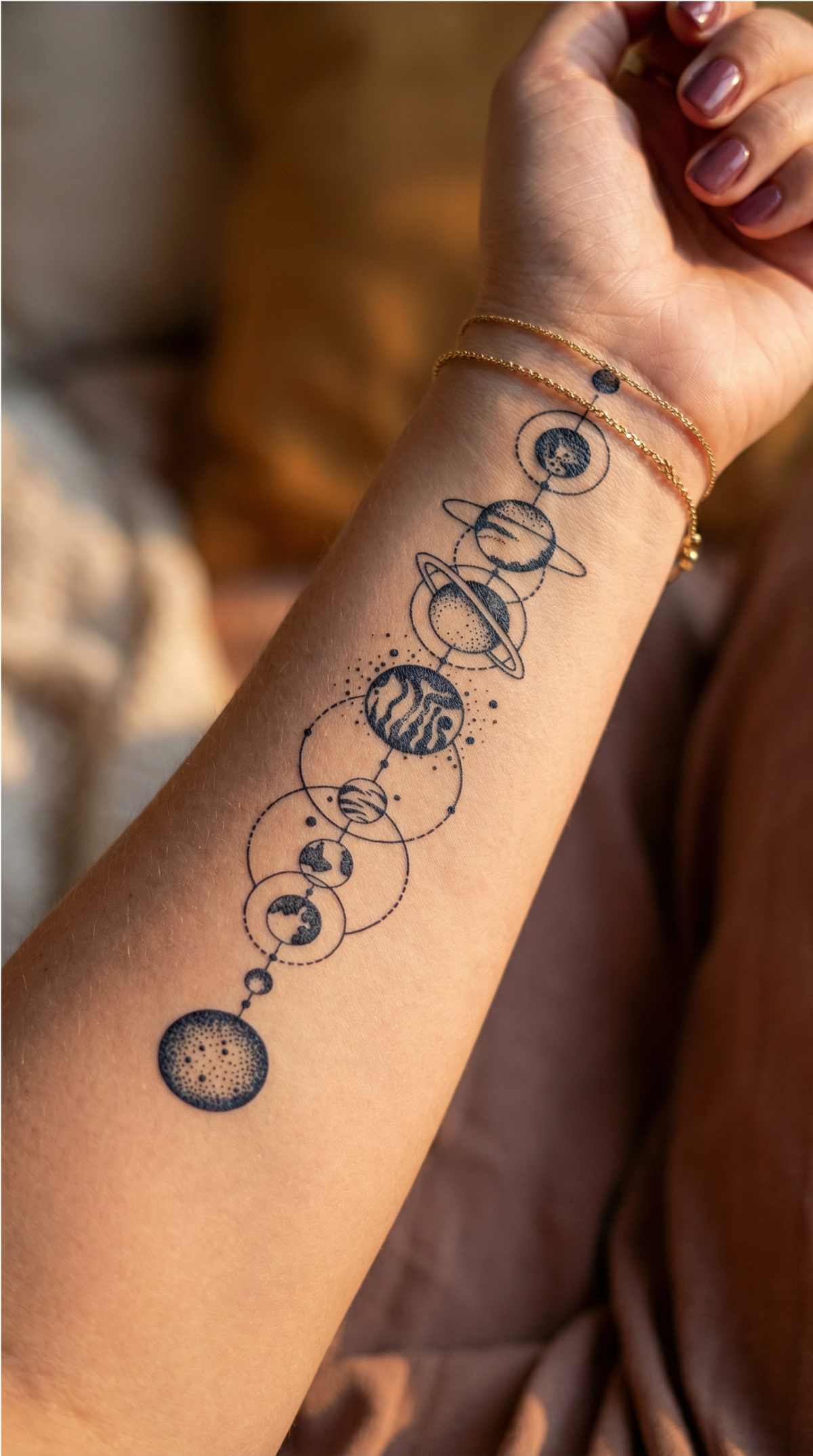

A dotwork tattoo is not a motif but a technique: the entire design is built up from individual dots rather than continuous lines or solid areas of ink. Place the dots close together and the area appears darker; space them further apart and it stays lighter, creating a gradual transition without a line ever coming into play (source: Dotwork Tattoos: Stipple, Gradient & Sacred Geometry). This construction from individual dots makes dotwork popular for mandalas, geometric patterns and ornate designs, where an even, symmetrical structure is what makes the design work.
- Dotwork is a technique, not a fixed motif: the density of the dots determines the shading and texture, not the subject of the tattoo.
- It is often combined with fine-line work: lines define the shape, while dots add shading and depth.
- Mandalas and geometric patterns work well with dotwork thanks to their symmetrical, repetitive structure.
- Choose a large enough scale for a pattern: very small or closely packed dots can run together on the skin.
- Because it is done dot by dot, dotwork often takes longer than simpler linework, especially for larger pieces.
What is a dotwork tattoo?
The basis of dotwork is stippling, the general drawing technique in which the density of the dots determines how dark an area looks: the closer the dots, the darker the shading (source: Stippling – Wikipedia). In the tattoo world, a distinction is often made between "dot work" in the strict sense, with evenly spaced dots, and stipple shading, in which the dots are clustered irregularly to create a rougher, textured effect. They are related but slightly different techniques, and a design can use both, depending on the effect the tattoo artist is looking for (source: What Is The Difference Between Dot Work, Whip Shading, and Stipple Shading).
Because each dot is placed individually, dotwork is usually a patient process, and that affects how long a design takes: larger pieces often require multiple sessions, simply because so many individual dots are needed to build up the right density (source: What Are Dotwork Tattoos? Unveiling the Artistry of Stippled Ink). Some tattoo artists use a regular tattoo machine that places dots in a steady rhythm; others deliberately choose the slower, manual "hand-poke" method, placing each dot by hand. The result looks similar, but the way the pattern is created differs.
Dotwork versus linework and fine line
Linework and fine line define the shape and edges of a design with clear, continuous lines. Dotwork does something different: it adds shading, texture and depth through the density of the dots, without needing a continuous line (source: Dotwork Tattoos: Complete Style Guide). In practice, the two techniques are often used together: a fine line defines the shape of, for example, a compass or a geometric symbol, and dotwork shading inside or around it gives the design volume. If you want to see exactly what pure linework looks like without that shading, you can find it in the article about fine-line tattoos.
Mandalas and geometric patterns in dotwork
A mandala is built around radial symmetry: shapes that extend outward from a central point in repeating layers (source: Mandala Tattoo: Meaning, Designs & Ideas for Men & Women). This structure naturally lends itself to dotwork, because evenly placed dots bring extra balance and structure to a symmetrical pattern. Dotwork draws on a long tradition of symmetrical, repeating ornamentation, from yantra diagrams to mandala painting and geometric ornament (source: Dotwork Tattoos: Stipple, Gradient & Sacred Geometry); these are traditions that deserve respect and should not be seen only as visual inspiration. To learn about the meaning of a mandala itself, separate from the technique used to draw it, read on in the article about mandala tattoos. For geometric shapes more broadly, beyond dotwork, the article about geometric tattoos is a good starting point. If you would rather browse the selection straight away, you can find symmetrical and geometric designs in the geometric tattoos collection.

Dotwork tattoo ideas for men and women
The technique itself is not tied to gender: in practice, what differs are personal preferences about size, placement and how visible someone wants the pattern to be day to day. A small, compact motif, such as a single symmetrical symbol, a compass or an infinity sign, works well as a discreet first design because it remains legible even at a small scale. A larger symmetrical piece on the chest, back or forearm gives a mandala-like radiating pattern the space it needs to look its best. Between those options, combining a simple linework symbol with light dotwork shading is a way to give a design more depth without making it feel heavy straight away. Placement plays just as big a role as the design itself: a wrist or ankle shows off a small pattern all day, while a spot on the ribs or thigh is easier to hide under clothing if you would rather start with a discreet piece.
If you want to look beyond mandalas and geometry, ornate patterns are a related direction; this is covered in more detail in the article about ornamental tattoos.

Patterns and combinations: when dotwork does and doesn't work
Dotwork reads best at a scale that gives the dot pattern room to stand out; very small or closely packed dots can run together on the skin once the design has been applied (source: Dotwork Tattoos: Complete Style Guide). Geometric line patterns, such as compass lines, interlocking shapes or repeating symbols, provide a natural basis for adding dotwork shading, within or around the lines. A design that combines a clear linework outline with dotwork texture is generally easier to read at a glance than a dense, even field of dots without clear contours.
Also bear in mind that dotwork takes longer than simpler styles precisely because it is done dot by dot; larger, dense patterns are therefore often spread across multiple sessions rather than completed all at once. If you're unsure between a solid area of dotwork and a lighter application, a pattern with open spaces between its elements is usually a safer choice than a design that covers almost all the skin with dots.
Try out a dotwork pattern before you decide
Because dotwork and geometric patterns depend so much on scale and placement to look their best, seeing the actual design on your own skin, in the spot and size you're considering, tells you more than a reference photo ever can. A temporary or semi-permanent geometric tattoo lets you see how a pattern such as a compass, an infinity symbol or a Yin Yang looks and reads on your skin before you decide on anything permanent. That design only tests the shape, size and placement; it says nothing about how a permanent dotwork tattoo would feel, heal or fade over time.
If the pattern works well at the size and placement you've tried, that's valuable information to take to a tattoo artist who works in dotwork. If you're still unsure which design or placement is right for you, the article about your first tattoo gives an overview of the choices involved.